

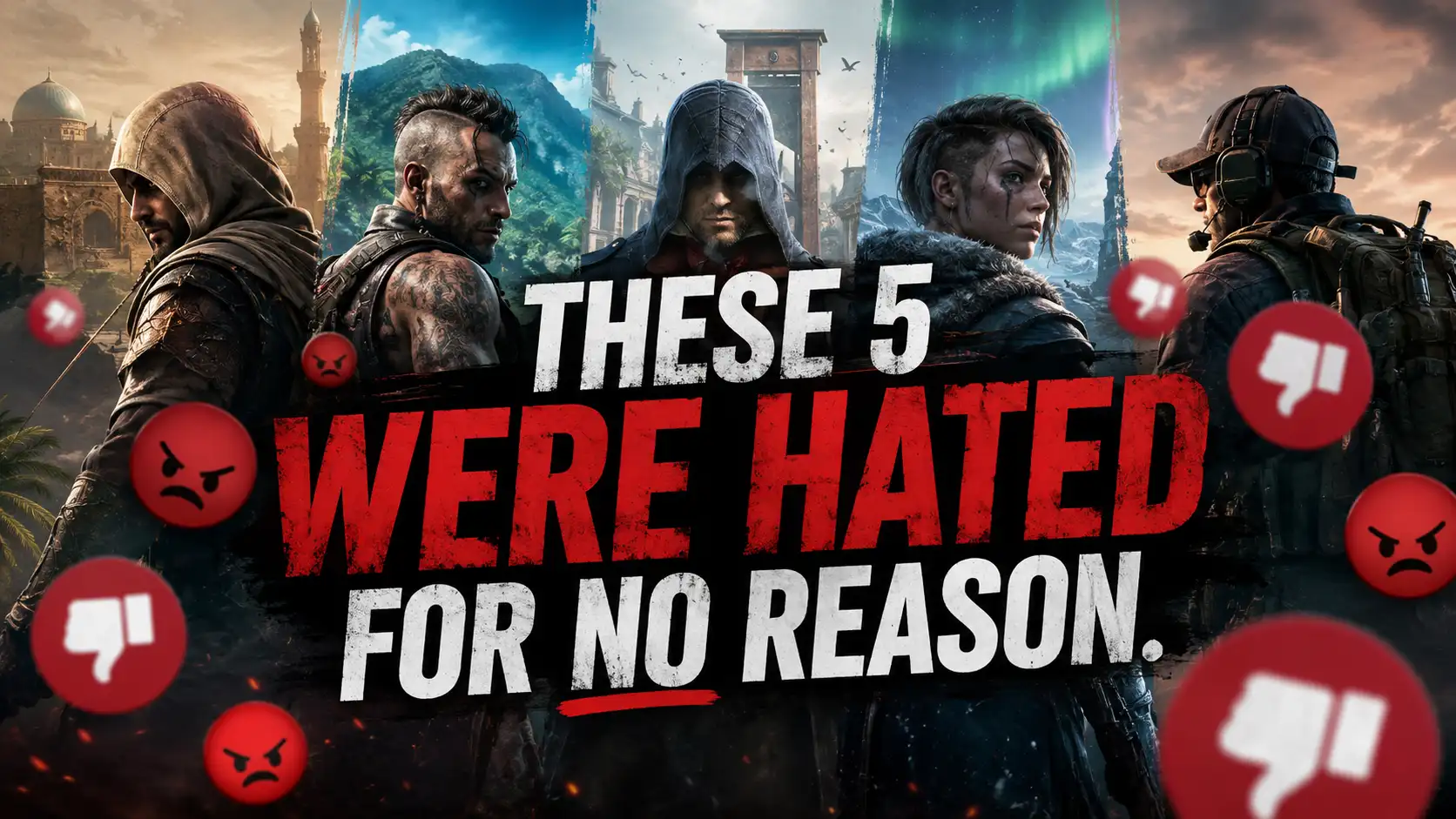
These 5 Ubisoft Games Were Hated for No Reason
Introduction
Ubisoft has spent decades building some of the most recognizable franchises in the gaming industry. From Assassin’s Creed and Far Cry to Ghost Recon, Rainbow Six, and Watch Dogs, the publisher has created games that millions of players immediately recognize. Its worlds are usually large, visually impressive, and filled with enough activities to keep players occupied for dozens of hours. Despite that success, Ubisoft has also become one of the easiest targets for criticism in modern gaming, with every new release immediately placed under a powerful microscope.
Some criticism aimed at Ubisoft is understandable. Several of its games have launched with technical problems, repetitive activities, questionable progression systems, or features that failed to match what players expected. However, there is a major difference between criticizing a genuine problem and treating an entire game as worthless because of a single controversy. Unfortunately, online gaming discussions often struggle to maintain that balance.
Once a negative opinion becomes popular, it spreads quickly through social media, YouTube videos, gaming forums, and comment sections. A handful of bugs can become proof that a game is completely broken. A graphical downgrade may suddenly appear more important than the gameplay itself. A different setting can be treated as evidence that the developers have lost their creativity. Before long, people who have never played the game begin repeating the same arguments as if they experienced everything firsthand.
That is exactly what happened to several Ubisoft titles. Some were buried under disastrous first impressions, while others were rejected simply because they did not follow the formula fans expected. Years later, many players have returned to these games and discovered ambitious worlds, memorable mechanics, and genuinely entertaining experiences that were overlooked during the original backlash.
None of the games on this list are perfect. Every one of them has weaknesses that deserve to be discussed honestly. Still, their negative reputations often became much larger than their actual problems. These five Ubisoft games were hated for no reason—or, more accurately, hated far more than they reasonably deserved.
Why Ubisoft Games Often Receive Harsh Criticism
Ubisoft occupies a difficult position in the gaming world. As one of the industry’s largest publishers, every major release arrives under an enormous spotlight. Players expect advanced graphics, polished performance, innovative mechanics, memorable characters, and hundreds of hours of content. When a title fails to deliver even one of those things, disappointment can quickly transform into anger.
The company is also closely associated with a recognizable style of open-world design. Large maps, visible objectives, collectible items, enemy bases, skill trees, and towers have appeared across several Ubisoft franchises. For many players, these systems are enjoyable because they provide clear goals and constant progression. For others, they have become symbols of repetitive design.
This reputation means new Ubisoft games are rarely judged without baggage. A title might introduce an interesting setting or an unusual gameplay mechanic, yet the conversation often returns to familiar complaints about the “Ubisoft formula.” That makes it harder for individual games to be evaluated based on what they actually accomplish.
The Reputation Problem
Ubisoft’s reputation has become a filter through which many players view everything it releases. Before a new title reaches stores, people may already assume that the map will be overloaded, the missions will feel repetitive, and the story will be forgettable. Those expectations can shape the experience before the player has even touched the controller. Similarities between Ubisoft games clearly exist, but a familiar structure does not automatically mean a game has no creativity. Two restaurants can serve the same type of food while still delivering completely different flavors, atmospheres, and levels of quality.
When players approach every Ubisoft game expecting disappointment, even strong features can be dismissed. Excellent environmental design becomes “just another open world,” creative combat systems become “another Ubisoft gimmick,” and ambitious historical locations are reduced to maps filled with icons. This attitude can prevent individual games from receiving credit for their strongest ideas while making relatively minor flaws appear far more serious than they actually are.
When Internet Narratives Take Over
Modern gaming opinions are often formed at incredible speed. A title launches, a bug compilation appears online, and within hours the entire game may be labeled a disaster. Social media rewards dramatic reactions, so balanced discussions rarely travel as far as angry posts, embarrassing clips, or sarcastic memes. A rare visual glitch might look hilarious in a short video, but viewers usually have no idea whether it happened once during a 40-hour playthrough or appeared every five minutes.
Once a narrative becomes popular, it is repeated until it feels unquestionably true. People stop asking whether the game has been improved, whether its systems are deeper than expected, or whether the original criticism was exaggerated. The reputation becomes permanent, even when the game itself changes. That pattern has affected many Ubisoft releases, turning complicated games with both strengths and weaknesses into easy punchlines.
5 Ubisoft Games That Were Better Than Critics Claimed
1. Assassin’s Creed Unity
The Launch Disaster That Overshadowed Everything
Assassin’s Creed Unity launched in 2014 with enormous expectations because it was presented as a major technical step forward for the franchise. Ubisoft promised a dense recreation of revolutionary Paris, huge crowds, detailed interiors, cooperative missions, and a redesigned parkour system. Unfortunately, much of that ambition collapsed under the weight of serious technical problems. Players reported unstable performance, animation errors, disappearing characters, broken artificial intelligence, and infamous facial glitches. Images of characters missing parts of their faces spread across the internet almost immediately, becoming some of the most recognizable gaming memes of the decade. The criticism was not invented, because Unity genuinely needed more development time before release. However, the discussion rarely moved beyond those failures. Even after patches improved the game’s technical condition, Unity continued to be described as one of the worst Assassin’s Creed titles, while many players never returned to see what had changed. Its broken first impression became a shadow that covered nearly everything else it tried to accomplish.
Why It Deserved More Appreciation
Beneath the launch problems was one of the most ambitious Assassin’s Creed experiences Ubisoft had ever created. Unity’s version of Paris remains one of the franchise’s most impressive urban environments, with crowded streets, political demonstrations, detailed architecture, explorable interiors, and a scale that still feels convincing years later. The redesigned parkour system gave players smoother control when climbing and descending buildings, making movement more graceful and deliberate than in many other entries. Its assassination missions also encouraged planning by offering different entrances, distractions, hidden paths, and opportunities to eliminate targets. Players could study an area, gather information, and create an approach that matched their preferred style rather than simply following a single route. Customizable equipment and skills added further variety, while the relationship between Arno and Élise gave the story an emotional center. Unity deserved criticism for launching unfinished, but it never deserved to be remembered only as a collection of faceless character models. Once its technical issues were reduced, the strength of its city, movement, stealth, and mission design became much easier to appreciate.
2. Watch Dogs
The Downgrade Controversy
Watch Dogs became one of the most anticipated games of its generation after Ubisoft revealed an impressive demonstration featuring dramatic lighting, detailed character animation, advanced environmental effects, and a living city controlled through technology. The presentation made the game look like a revolutionary showcase for new gaming hardware, causing expectations to rise to unrealistic levels. When the final product arrived, players quickly noticed differences between the early demonstration and the retail release. Lighting had changed, certain effects appeared less advanced, and the overall presentation did not fully match what audiences remembered. Comparison videos attracted enormous attention, and the word “downgrade” became permanently attached to the game. The frustration was understandable because publishers should represent upcoming products honestly, but the reaction became so dominant that Watch Dogs was judged against an idealized promotional demonstration rather than evaluated as the game that actually existed. Criticism of Aiden Pearce’s serious personality further contributed to the negative narrative, encouraging many players to treat the game as a complete disappointment without examining its mechanics, atmosphere, or original ideas.
What Players Missed
The central hacking system gave Watch Dogs a strong identity that separated it from other urban open-world games. Players could access cameras, manipulate traffic lights, raise bridges, activate road barriers, disrupt communications, unlock doors, and interact with electronic devices across Chicago. The city was not merely scenery; it functioned like a massive tool that could be used during chases, stealth missions, and combat encounters. Instead of simply driving faster than the police, players could cause collisions at intersections or raise a bridge at the perfect moment. Cameras allowed them to scout restricted areas, mark targets, create distractions, and complete certain objectives without entering the location directly. Chicago’s rainy streets, industrial districts, and cold visual atmosphere also supported the game’s themes of surveillance, personal data, and technological control. Profiling civilians revealed brief private details about their lives, reminding players that digital information could reduce people to searchable records. Watch Dogs may not have delivered the visual revolution suggested by its reveal, but it introduced a gameplay concept strong enough to support an entire franchise. Its reputation became tied to what had been reduced rather than what the final game successfully created.
If you enjoy exploring unique worlds and discovering hidden secrets in games, don’t miss 6 Amazing Open-World Games Filled with Mysteries and Magic, where you’ll find some of the most immersive fantasy adventures packed with exploration, supernatural elements, and unforgettable discoveries.
3. Far Cry Primal
Why Fans Rejected It
Far Cry had become known for automatic weapons, explosive vehicles, chaotic firefights, and memorable villains, so transporting the franchise to the Stone Age seemed like a strange decision. Far Cry Primal replaced rifles, helicopters, and rocket launchers with bows, clubs, spears, fire, and animal companions. Many fans immediately assumed that the combat would become repetitive without modern weapons, while others viewed the game as a smaller experiment rather than a legitimate Far Cry release. Concerns also appeared around the story because a prehistoric setting lacked the modern politics, technology, and social conflicts usually associated with the series. The discovery that its underlying map shared structural similarities with Far Cry 4 further strengthened the accusation that Ubisoft had created a low-effort product from reused material. These concerns were not completely unreasonable, but they caused many players to reject Primal without considering how thoroughly its world, combat, survival systems, and progression had been rebuilt around prehistoric life. It was judged for what it removed before audiences seriously examined what it added.
The Unique Experience It Delivered
Primal’s greatest achievement was its atmosphere. The land of Oros feels beautiful during the day and genuinely dangerous after sunset, with dense forests, rivers, caves, frozen regions, hostile tribes, and predators that can attack without warning. Primitive combat feels physical because spears strike with visible force, clubs require players to fight at close range, and bows reward patience and accuracy. The animal-taming system gives the game a personality no other Far Cry entry fully shares, allowing players to recruit wolves, bears, sabertooth tigers, and other creatures that support different tactics. An owl can scout enemy locations from above, while village development creates a satisfying sense of progress as rescued specialists and gathered resources strengthen the Wenja community. The game still uses familiar Ubisoft activities such as outposts, crafting, upgrades, and map exploration, but the setting changes their emotional meaning. Capturing territory feels less like clearing another military checkpoint and more like creating a safer home in a world where humanity has not yet become the dominant force. Far Cry Primal was not a reduced version of Far Cry; it was one of the franchise’s boldest reinterpretations.
4. Ghost Recon Breakpoint
A Rough Start
Ghost Recon Breakpoint launched with a serious identity problem. Fans expected a tactical military shooter that expanded on Ghost Recon Wildlands, but the game introduced gear scores, colored loot, weapon levels, and progression systems more commonly associated with looter-shooters. These mechanics clashed with the franchise’s focus on tactical realism, especially when equipment statistics became more important than military planning. The fictional island of Auroa also felt strangely empty compared with the culturally rich version of Bolivia found in Wildlands. Technical problems, awkward animations, inconsistent artificial intelligence, and the absence of AI teammates at launch created additional frustration. Microtransaction concerns damaged trust even further by making players question whether the progression systems had been designed around optional purchases rather than the quality of the experience. Breakpoint seemed less like a focused Ghost Recon game and more like a collection of popular industry trends forced into the same product. The launch criticism was therefore understandable, because the original version struggled to decide whether it wanted to be a tactical shooter, a survival experience, or an online loot-driven game.
The Massive Improvements After Launch
Ubisoft responded with updates that substantially changed Breakpoint and allowed players to remove many of the systems they disliked. Ghost Experience introduced options to disable gear scores, adjust injuries, modify stamina, remove interface elements, change enemy difficulty, and customize survival mechanics. Instead of forcing everyone to play one specific version, the game eventually allowed players to build the tactical experience they preferred. AI teammates returned, restoring squad-based gameplay for solo players and providing commands, coordinated attacks, and synchronized shots. Additional missions, enemy types, customization options, and gameplay refinements improved the overall package, while Auroa’s forests, mountains, laboratories, and military compounds became a versatile tactical playground. Players could parachute from helicopters, crawl through mud, use drones, cut fences, eliminate guards silently, or attack with overwhelming force. The island never gained the same personality as Wildlands’ Bolivia, and some structural weaknesses remained, but the improved version became far more focused and enjoyable. Breakpoint cannot erase its disappointing launch, yet judging its current form entirely through its original reputation ignores years of meaningful changes.
5. Immortals Fenyx Rising
Lost in the Shadow of Bigger Franchises
Immortals Fenyx Rising arrived without the enormous name recognition of Assassin’s Creed, Far Cry, or Ghost Recon. It launched during a crowded period and immediately faced comparisons with other colorful open-world adventure games because of its climbing, gliding, stamina system, puzzles, and stylized art direction. Many players dismissed it as an imitation instead of evaluating how those familiar ideas were combined. Its humorous presentation created another challenge because Ubisoft’s major franchises usually rely on serious historical conflicts, realistic violence, or darker themes. The constant jokes and playful narration caused some players to assume the game lacked depth or was designed only for younger audiences. Its identity was also less clear because it was a new property competing against established franchises with loyal fan bases. Immortals was not attacked as aggressively as Unity or Breakpoint, but it was frequently underestimated and reduced to comparisons that prevented it from receiving the attention it deserved.
Why It Was Better Than Expected
Immortals Fenyx Rising delivered one of Ubisoft’s most consistently entertaining open worlds by combining exploration, mythology, combat, platforming, and puzzle-solving in a focused package. Its regions were inspired by different Greek gods, giving forests, palaces, ruined temples, corrupted areas, and volcanic landscapes distinct visual identities. Puzzles were central to the experience rather than minor distractions, asking players to move objects, redirect energy, activate mechanisms, identify environmental clues, and complete puzzle-focused vaults. Fenyx could climb, glide, ride mounts, and use special abilities to reach hidden areas, while exploration rewarded curiosity with equipment, upgrades, mythology challenges, and secret encounters. Combat mixed light and heavy attacks with parries, dodges, aerial moves, environmental objects, and godly powers that could be combined creatively against minotaurs, cyclopes, and other legendary creatures. The humorous conversations between Zeus and Prometheus gave the adventure an unusual personality, presenting the gods as powerful but deeply flawed characters. Immortals borrowed recognizable ideas, but it combined them into a polished, charming, and genuinely enjoyable game that deserved to be evaluated as more than a comparison to other franchises.
The Role of First Impressions in Gaming
First impressions have enormous power in the gaming industry. Players usually decide whether to purchase a title based on trailers, reviews, launch coverage, and early community reactions. When those first impressions are negative, a game may lose its audience before developers have time to improve anything.
A broken launch is especially damaging because technical failures produce clear and easily shareable evidence. Videos of crashes, glitches, and poor performance spread much faster than detailed explanations about mission design, environmental storytelling, or long-term progression. Even when patches solve the original problems, the embarrassing footage remains online forever.
Expectations can be equally dangerous. Watch Dogs was not judged only as an open-world hacking game; it was judged against an impressive early presentation. Far Cry Primal was not evaluated only as a prehistoric survival adventure; it was compared with what fans believed a Far Cry game was supposed to include. When expectations become rigid, anything different can feel like failure.
Players should still demand polished products and honest marketing. Giving a title a second chance does not mean excusing unfinished launches or misleading presentations. It simply means recognizing that a game’s overall quality may be more complicated than its original reputation suggests.
How Ubisoft Games Age Better Than Expected
Many Ubisoft games improve with age because their largest weaknesses are often technical or adjustable rather than fundamental. Performance can be stabilized, bugs can be patched, progression systems can be redesigned, and controversial features can be made optional. Once those issues are addressed, the underlying world and gameplay become easier to appreciate.
Time also changes expectations. A player returning to Assassin’s Creed Unity years later is no longer waiting for the revolutionary next-generation experience promised during its original marketing campaign. They can simply explore Paris, enjoy the parkour system, and evaluate the missions without the pressure created by launch hype.
Discounts and complete editions can also improve the value of older releases. A game that felt disappointing at full price may become an excellent purchase when it includes years of updates, expansions, and additional content at a lower cost. The relationship between price, expectations, and satisfaction can dramatically reshape how players view a title.
Ubisoft’s commitment to post-launch support has helped several troubled games recover. That does not justify releasing unfinished products, but it does mean the final versions can be much stronger than the editions reviewed on release day. Players who refuse to revisit them may unknowingly judge outdated experiences that no longer accurately represent the current games.
What These Games Teach Us About Gaming Communities
Gaming communities are powerful because they can expose technical problems, challenge dishonest marketing, and pressure publishers to improve their products. The backlash against Unity’s launch and Breakpoint’s unwanted progression systems encouraged Ubisoft to make important changes. Without vocal criticism, those improvements might never have happened.
However, criticism becomes less useful when it transforms into permanent hostility. A community that refuses to acknowledge updates is no longer evaluating the game itself; it is protecting an old narrative. That attitude discourages nuance and makes honest conversations difficult.
Players should also separate personal preference from objective failure. Someone who dislikes prehistoric settings may not enjoy Far Cry Primal, but that does not automatically make the game poorly designed. A player who prefers serious storytelling may dislike the humor in Immortals Fenyx Rising, while others may consider it refreshing. Different tastes do not require one side to declare the other wrong.
The best approach is to remain skeptical without becoming closed-minded. Players can examine reviews, watch gameplay, understand the criticism, and then decide whether the experience matches their preferences. Internet opinions can provide useful guidance, but they should never completely replace personal judgment.
Conclusion
Ubisoft has made real mistakes, and several games on this list deserved criticism for their launch conditions, marketing, or design decisions. Assassin’s Creed Unity released with unacceptable technical problems, Watch Dogs created expectations its final presentation could not fully satisfy, and Ghost Recon Breakpoint initially forced incompatible progression systems into a tactical military franchise.
Yet those problems do not tell the entire story. Unity also delivered a spectacular version of Paris, excellent parkour, and flexible assassination missions. Watch Dogs introduced a city that could be manipulated through hacking. Far Cry Primal transformed a familiar formula with primitive weapons, dangerous wildlife, and animal companions. Breakpoint evolved into a customizable tactical sandbox, while Immortals Fenyx Rising offered a charming mixture of Greek mythology, puzzles, exploration, combat, and humor.
These games were never secretly perfect, but they were far better than the loudest criticism suggested. Their reputations were shaped by first impressions, viral narratives, unrealistic expectations, and comparisons that often left little room for balanced evaluation.
The next time the internet declares a game completely worthless, it may be worth looking beyond the most popular reaction. Sometimes a flawed title still contains a remarkable experience, and sometimes the game everyone loves to criticize is simply waiting for someone to give it a fair chance.
FAQs
1. Is Assassin’s Creed Unity worth playing today?
Yes. Its major technical problems have been reduced through updates, allowing its detailed recreation of Paris, fluid parkour system, stealth mechanics, and open-ended assassination missions to stand out much more clearly. It still has occasional flaws, but the current experience is far better than its launch reputation suggests.
2. Why did the original Watch Dogs receive so much criticism?
Much of the criticism came from the visual differences between its early promotional demonstration and the final release. That controversy overshadowed its interactive hacking mechanics, atmospheric recreation of Chicago, creative vehicle chases, and themes involving privacy and digital surveillance.
3. Is Far Cry Primal repetitive without guns?
Far Cry Primal still uses some familiar open-world activities, but primitive weapons, dangerous wildlife, survival mechanics, and animal companions create a different rhythm from other Far Cry games. Players who enjoy exploration, hunting, and close-range combat may find it more distinctive than repetitive.
4. Did Ghost Recon Breakpoint become better after launch?
Yes. Ubisoft added Immersive Mode, adjustable gameplay settings, AI teammates, additional missions, and numerous mechanical improvements. These updates allowed players to remove gear scores and transform the game into a more traditional tactical military sandbox.
5. Why did Immortals Fenyx Rising fail to receive more attention?
The game launched in a crowded market, lacked the recognition of Ubisoft’s larger franchises, and was frequently compared with other open-world adventures. Its colorful art style and humorous tone also led some players to underestimate its puzzles, combat, exploration, and creative use of Greek mythology.