

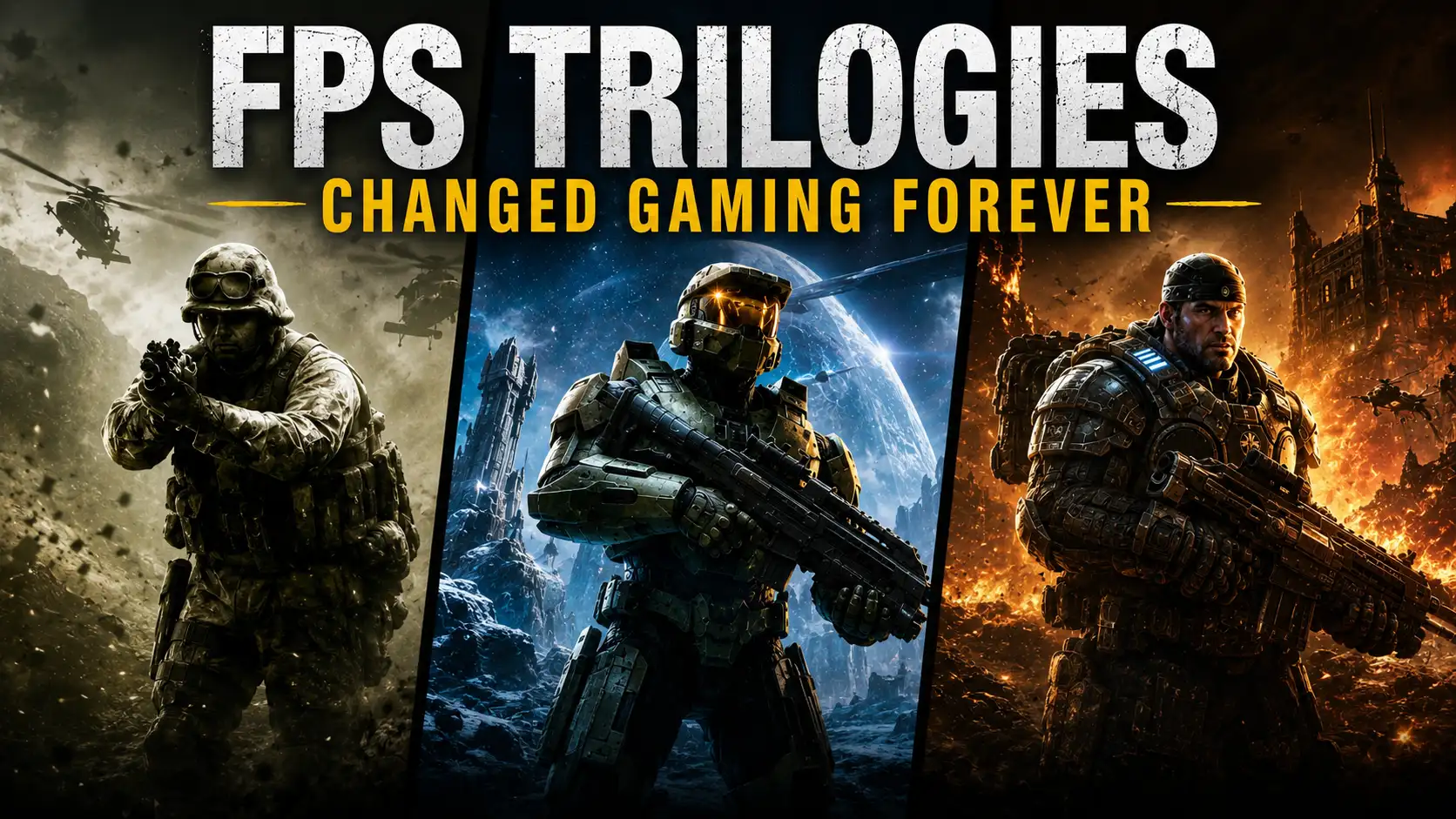
First-person shooters have always been one of the most influential genres in gaming history. Long before open-world adventures and battle royale games dominated the industry, FPS titles were already shaping how players interacted with virtual worlds. The simple concept of seeing the game through the eyes of the character created a level of immersion that few other genres could match. Players weren’t just controlling heroes from a distance anymore because they became the hero directly inside the action.
Back in the early days of gaming, FPS titles were relatively straightforward. Most of them focused purely on shooting enemies, collecting ammo, and surviving dangerous levels filled with traps and monsters. Storytelling was usually minimal, graphics were limited by technology, and multiplayer barely existed outside local connections. Yet even with those limitations, FPS games managed to create adrenaline-filled experiences that players instantly fell in love with.
As gaming technology evolved, the FPS genre evolved alongside it. Developers began experimenting with cinematic storytelling, realistic physics, smarter enemy AI, and immersive environments. Suddenly, FPS games were no longer just about reflexes and fast shooting. They became emotional journeys, competitive playgrounds, and storytelling masterpieces capable of rivaling blockbuster movies.
Over the years, many franchises entered the FPS market, but only a handful truly changed gaming forever. Some introduced mechanics that became industry standards, while others completely transformed how players viewed multiplayer gaming. A few even proved that shooters could deliver philosophical themes and emotional depth instead of relying only on explosions and action scenes.
The trilogies on this list are more than just successful game franchises because they are milestones in gaming history. Their influence can still be felt in modern shooters today, whether through storytelling techniques, gameplay mechanics, online multiplayer systems, or level design philosophies.
These legendary trilogies didn’t simply entertain millions of gamers around the world because they inspired future developers, created unforgettable memories for players, and pushed the gaming industry into entirely new directions.
Why FPS Trilogies Leave a Bigger Legacy
There’s something uniquely powerful about trilogies in gaming. A single game can become iconic, but a trilogy allows developers to fully expand their vision over multiple releases. It gives them the opportunity to refine gameplay systems, deepen storytelling, improve graphics, and create stronger emotional bonds between players and characters.
Think about your favorite movie trilogies for a second. The reason they become unforgettable is because audiences spend years growing alongside the characters and worlds. FPS trilogies work the exact same way because players become emotionally invested after experiencing long-term journeys instead of isolated adventures.
The first game usually introduces players to the core mechanics and world-building. The second game often expands everything, making the universe bigger and the gameplay deeper. The third installment typically delivers the emotional payoff and cements the franchise’s legacy forever.
This structure creates a stronger impact than standalone titles because players feel attached to the franchise over time. They remember the excitement of midnight launches, multiplayer matches with friends, shocking story twists, and unforgettable boss battles. Those memories eventually become part of gaming culture itself.
Another reason FPS trilogies leave such a massive legacy is because developers learn from previous installments. Each sequel improves upon the strengths and weaknesses of earlier games. By the time a trilogy concludes, the franchise often reaches a level of polish and refinement that defines an entire era of gaming.
The trilogies on this list achieved exactly that. They didn’t just release multiple successful games because they continuously evolved and pushed the boundaries of what FPS games could accomplish.
What Makes an FPS Trilogy Truly Legendary?
Not every popular FPS franchise deserves legendary status. Some games dominate sales charts for a few years and then slowly fade away once trends change. Truly legendary trilogies are different because their influence survives long after their release dates.
A legendary FPS trilogy usually changes the gaming industry in several important ways. First, it introduces innovative mechanics or design philosophies that future developers copy and improve upon. Second, it creates memorable characters and worlds that remain recognizable even decades later. Third, it leaves a cultural impact that extends beyond gaming itself.
The most important factor, however, is longevity. Great trilogies continue attracting new players years after launch because their gameplay remains enjoyable and relevant. They age gracefully instead of feeling outdated.
Legendary FPS trilogies also tend to create communities around them. Fans continue discussing theories, replaying campaigns, organizing multiplayer events, creating mods, and sharing nostalgic memories online. That kind of lasting passion cannot be manufactured artificially because it happens naturally when a game genuinely connects with people.
Another key trait is influence. When modern developers design FPS games today, many of them still borrow ideas introduced by the trilogies on this list. Features that now feel standard in shooters often originated from these groundbreaking franchises.
These trilogies didn’t follow trends because they created entirely new standards for the industry.
Best FPS Trilogies Ever
1. Half-Life Trilogy
Storytelling Became Cinematic
When people discuss revolutionary FPS games, the Half-Life series almost always becomes part of the conversation. Developed by Valve, Half-Life fundamentally changed how stories were presented in first-person shooters. Before Half-Life arrived, storytelling in FPS games was usually treated as secondary because players simply received a short introduction before jumping straight into gameplay.
Half-Life changed that formula by allowing the story to unfold naturally while players remained in control of Gordon Freeman. Conversations happened in real time, scripted events occurred dynamically, and the environment itself became part of the storytelling process. This immersive approach made players feel physically present inside the game world instead of simply watching events happen from the outside.
How Half-Life Redefined Immersion
Half-Life’s immersive design influenced nearly every story-driven FPS that came afterward. Instead of relying heavily on cutscenes, the game delivered exposition organically through gameplay, environmental details, and NPC interactions that felt believable and natural.
The immersion became even stronger in Half-Life 2, where ruined cities, oppressive governments, and resistance movements created a dystopian atmosphere players could emotionally connect with. That level of immersion helped redefine storytelling standards for modern FPS games.
The Impact of Physics and AI
Half-Life 2 also revolutionized gameplay mechanics through advanced physics systems and smarter enemy AI. The Gravity Gun became one of gaming’s most iconic weapons because it allowed players to manipulate objects creatively during puzzles and combat situations.
Enemy AI also felt more dynamic compared to most shooters of that era. Opponents flanked players, adapted to situations intelligently, and coordinated attacks, which made combat encounters feel tense and unpredictable throughout the experience.
Why Gamers Still Talk About Half-Life Today
Even decades later, gamers continue discussing theories, hidden details, and unanswered mysteries surrounding the Half-Life universe. The franchise created a mysterious atmosphere that encouraged fans to analyze every small detail and speculate endlessly online.
The long absence of major sequels also turned Half-Life into a cultural phenomenon within gaming history. Few FPS franchises maintain the same level of respect and discussion so many years after release.
2. Halo Trilogy
The Console FPS Revolution
Before Halo, console shooters often struggled to compete with PC FPS games because many developers believed controllers couldn’t deliver precise shooting mechanics. Then Bungie released Halo and completely changed the perception of console FPS gaming. The franchise successfully proved that first-person shooters could feel smooth, competitive, and highly immersive even when played using controllers instead of traditional keyboard and mouse setups.
The original Halo trilogy transformed console gaming by refining aiming mechanics, balancing weapons carefully, and introducing gameplay systems that felt comfortable for both casual and competitive players. At the same time, Halo helped establish the Microsoft Xbox as one of the gaming industry’s biggest platforms. Without Halo’s success, Xbox might never have become such a dominant force in modern gaming culture.
Halo’s Multiplayer Explosion
Halo multiplayer became one of the most important social gaming experiences of its generation because players gathered together for LAN parties and competitive matches that lasted for hours. Before online matchmaking became mainstream, gamers carried televisions, consoles, and controllers to friends’ houses just to experience multiplayer battles together in the same room.
The gameplay itself felt nearly perfect for competitive multiplayer because the weapon balance, map layouts, movement systems, and vehicle combat all worked together naturally. Every multiplayer match created exciting moments that felt cinematic and unpredictable, which is why many gamers still remember Halo multiplayer as one of the greatest gaming experiences ever created.
Master Chief Became an Icon
Every legendary trilogy needs a memorable protagonist, and Halo delivered one of gaming’s most recognizable heroes with Master Chief. Unlike many loud and overly expressive action heroes, Master Chief remained calm, mysterious, and intimidating throughout the series, which made the character feel even more iconic and memorable.
His armor design instantly became associated with Xbox gaming itself, helping Master Chief evolve into one of the biggest mascots in gaming history. Even people who never played Halo could still recognize the character immediately because of how influential and popular the franchise became around the world.
How Halo Changed Xbox Forever
Halo’s success played an enormous role in helping Xbox compete against rival consoles during its early years because the franchise gave Microsoft a strong gaming identity. The popularity of Halo helped convince millions of gamers that Xbox could successfully compete with other major gaming brands.
The series also accelerated the growth of Xbox Live and online multiplayer gaming by popularizing features like matchmaking systems, voice chat, ranking mechanics, and competitive online communities. Modern console multiplayer gaming owes a massive debt to what Halo accomplished during its peak popularity.
If you enjoy legendary gaming franchises, don’t miss These 10 Nintendo Switch 2 Games Are Absolutely Worth Playing for more must-play titles every gamer should experience.
3. Call of Duty: Modern Warfare Trilogy
Blockbuster Gaming Was Born
The original Call of Duty: Modern Warfare trilogy transformed FPS gaming into cinematic blockbuster entertainment unlike anything players had experienced before. Developed by Infinity Ward and published by Activision, the series became one of the most influential franchises in gaming history because it combined explosive action, emotional storytelling, and addictive multiplayer systems into one complete package.
Before Modern Warfare arrived, many military shooters focused heavily on World War II settings and historical warfare scenarios. Modern Warfare changed that formula completely by introducing modern military combat filled with advanced technology, political tension, urban warfare, and cinematic missions that felt inspired by Hollywood action movies rather than traditional war games.
The Shift From WWII to Modern Combat
Modern Warfare’s modern setting immediately helped the franchise stand out from competitors because it introduced players to contemporary military operations involving sniper missions, helicopter assaults, covert infiltration, and large-scale urban combat. The realism and intensity of these scenarios made the experience feel fresh and exciting compared to older military shooters.
The game constantly delivered explosive moments through scripted events, dramatic pacing, and intense combat situations without taking control away from players. That cinematic presentation style became massively influential across the gaming industry because many developers began designing shooters that focused heavily on immersive blockbuster experiences afterward.
Multiplayer Addiction and Online Competition
Modern Warfare’s multiplayer mode completely transformed online gaming culture by introducing progression systems that rewarded players constantly. Gamers unlocked weapons, perks, killstreak rewards, and attachments after completing matches, which created an addictive gameplay loop that encouraged players to continue grinding for hours.
This progression-based multiplayer design became one of the most influential systems in gaming history because modern shooters still use similar ranking systems and unlock mechanics today. The competitive nature of Modern Warfare multiplayer also helped push online gaming into mainstream popularity worldwide.
Memorable Missions That Defined an Era
Modern Warfare delivered some of the most unforgettable missions ever created in FPS history because many of its levels combined emotional storytelling with cinematic gameplay perfectly. Missions like “All Ghillied Up” became legendary because of their stealth mechanics and tense atmosphere, while “No Russian” shocked players worldwide because of its controversial and disturbing content.
These missions proved that FPS games could create emotional reactions similar to movies while still maintaining engaging gameplay mechanics. Players remembered these moments for years afterward because the missions left such a strong emotional and psychological impact during the campaign experience.
4. BioShock Trilogy
FPS Games Could Be Philosophical
Most FPS games focus heavily on explosions, combat, and nonstop action sequences, but BioShock approached the genre in a completely different way. Developed by Irrational Games, the BioShock trilogy combined shooter gameplay with philosophy, morality, politics, and psychological storytelling in ways that felt unique and intellectually ambitious compared to traditional FPS franchises.
The series constantly challenged players emotionally and philosophically by forcing them to think about morality, manipulation, free will, and human nature throughout the story. This deeper narrative approach helped BioShock stand out from other shooters because it treated players as thinkers instead of simply focusing on action and explosions.
The Atmosphere of Rapture and Columbia
The underwater city of Rapture and the floating city of Columbia remain two of the most unforgettable settings in gaming history because both environments felt alive with history, tragedy, and ideology. Every hallway, abandoned room, poster, and audio recording contributed to the storytelling experience in meaningful ways.
Rapture represented the collapse of unchecked greed and ambition, while Columbia explored themes involving nationalism, racism, and political extremism hidden beneath its beautiful appearance. Exploring these worlds felt less like progressing through normal FPS levels and more like uncovering the hidden history of broken societies.
Narrative Choices and Moral Questions
BioShock constantly presented players with moral questions and philosophical themes that felt far deeper than most shooters released during that era. The series explored topics like control, manipulation, free will, and human selfishness through both gameplay and storytelling simultaneously.
The famous “Would you kindly?” twist became one of gaming’s most iconic moments because it completely changed how players viewed narrative control inside video games. That shocking reveal demonstrated how powerful storytelling in FPS games could become when developers focused on emotional and psychological depth.
Why BioShock Felt Different From Other Shooters
BioShock stood out because it successfully blended multiple genres together into one unforgettable experience. The franchise mixed FPS combat with horror mechanics, RPG systems, exploration gameplay, and emotionally driven storytelling that constantly rewarded curious players.
Players didn’t just remember BioShock because of its gunplay or action sequences because they also remembered its atmosphere, philosophical themes, emotional moments, and unforgettable environments. Very few FPS franchises managed to feel as intelligent and emotionally layered as BioShock throughout its trilogy.
5. DOOM Trilogy
The Grandfather of Fast-Paced FPS
You simply cannot discuss the history of first-person shooters without mentioning DOOM because the franchise helped establish many of the gameplay foundations still used in modern FPS games today. Created by id Software, DOOM introduced players to fast-paced combat, nonstop action, and chaotic gameplay that completely changed the gaming industry during its release period.
Unlike many modern shooters that focus heavily on realism and cinematic storytelling, DOOM prioritized speed, aggression, and adrenaline above everything else. That gameplay philosophy made the franchise feel unique because every battle encouraged players to move constantly, attack aggressively, and survive overwhelming chaos without slowing down.
DOOM’s Influence on Game Design
DOOM introduced many gameplay mechanics and design philosophies that later became standard features in FPS games. Fast movement, maze-like level design, hidden secrets, powerful weapons, and active modding communities all became strongly associated with the genre because of DOOM’s massive influence across gaming history.
The franchise also helped popularize deathmatch multiplayer, which eventually evolved into one of the earliest forms of competitive online gaming. Countless FPS developers borrowed ideas from DOOM because the series established such a strong gameplay foundation that influenced shooters for decades afterward.
Speed, Chaos, and Heavy Metal Energy
What made DOOM truly special was its nonstop energy and intense gameplay pacing because players were constantly surrounded by enemies, explosions, and aggressive combat encounters. The game rewarded movement and aggression instead of encouraging players to hide behind cover cautiously during battles.
Combined with its heavy metal soundtrack, violent action, and demon-filled environments, DOOM created one of the most adrenaline-filled gaming experiences ever made. Every level felt chaotic, explosive, and exciting from beginning to end, which helped the franchise stand out from slower-paced shooters.
Why DOOM Still Feels Modern
Despite being decades old, DOOM still feels surprisingly modern because its core gameplay mechanics remain timeless and satisfying even today. The combat system focuses on speed, instinct, aggressive movement, and responsive gunplay instead of relying on unnecessary gimmicks or overly cinematic mechanics.
Modern DOOM reboots successfully proved that the franchise’s gameplay formula still works perfectly in the modern gaming industry. Few FPS franchises remain as influential and enjoyable across multiple generations of gamers as DOOM continues to be today.
How These Franchises Influenced Modern FPS Games
Modern FPS games owe an enormous debt to these legendary trilogies. Half-Life influenced narrative immersion and environmental storytelling. Halo revolutionized console multiplayer systems. Modern Warfare transformed online progression mechanics. BioShock elevated storytelling depth. DOOM perfected fast-paced combat design.
If you examine modern shooters closely, you’ll notice traces of these franchises everywhere because developers continue borrowing ideas introduced by these games even years later.
These trilogies didn’t just shape the FPS genre because they shaped gaming as a whole.
The Rise of Competitive Multiplayer Because of FPS Trilogies
Competitive gaming culture grew massively because of FPS franchises like Halo, DOOM, and Modern Warfare. LAN tournaments evolved into esports competitions watched by millions worldwide because FPS games naturally encouraged competition and teamwork.
Today, online shooters dominate streaming platforms, esports events, and gaming communities globally. That massive competitive ecosystem exists partly because these trilogies helped popularize multiplayer gaming on a global scale.
Without these franchises, modern esports culture might look completely different today.
Why Nostalgia Keeps These Games Alive
Nostalgia plays a huge role in gaming culture because players remember late-night gaming sessions with friends, unforgettable story moments, and competitive matches that lasted for hours.
These trilogies became emotional landmarks in gamers’ lives because they were part of childhood memories, friendships, and personal experiences that players still treasure today.
Replaying them feels like revisiting a specific chapter of personal history, and that emotional connection keeps these franchises alive across generations.
The Future of FPS Gaming
The FPS genre continues evolving rapidly through virtual reality, AI-driven gameplay, advanced graphics, and massive online experiences. Yet despite technological advancements, the foundations created by these legendary trilogies remain deeply embedded within modern game design.
Future shooters may look different, but their DNA still traces back to Half-Life, Halo, Modern Warfare, BioShock, and DOOM because these franchises established many of the standards the industry still follows today.
That level of influence is what truly makes these trilogies timeless.
Conclusion
FPS games have evolved dramatically over the years, but the five trilogies on this list stand above the rest because they fundamentally changed gaming forever.
Half-Life transformed storytelling and immersion. Halo revolutionized console multiplayer gaming. Modern Warfare created blockbuster online competition. BioShock proved shooters could deliver philosophical depth. DOOM established the fast-paced foundation of the entire genre.
Together, these franchises inspired generations of developers and players while shaping the identity of modern FPS gaming itself. Their impact still exists in nearly every shooter released today, proving that true gaming legends never fade away.
FAQs
1. Why are FPS trilogies so popular among gamers?
FPS trilogies allow players to build long-term emotional connections with characters, worlds, and gameplay systems over multiple games.
2. Which FPS trilogy had the biggest impact on multiplayer gaming?
The Modern Warfare trilogy and Halo trilogy both massively influenced online multiplayer and competitive gaming culture.
3. Is DOOM still worth playing today?
Absolutely. DOOM’s fast-paced gameplay still feels incredibly satisfying and modern even decades later.
4. Why is Half-Life considered revolutionary?
Half-Life changed FPS storytelling by creating immersive narratives without relying heavily on cutscenes.
5. What made BioShock different from other FPS games?
BioShock combined shooter gameplay with philosophy, moral choices, political themes, and atmospheric storytelling, making it far deeper than typical FPS games.