

Running a business without the right systems in place is a little like trying to drive across the country with no GPS, no roadmap, and half a tank of gas. At first, things may seem manageable because your team is still small, workflows are simple, and daily operations can be controlled manually without too many complications. However, as your company starts growing, things begin changing rapidly. Departments become busier, customer demands increase, communication between teams becomes harder to manage, and important business data starts spreading across multiple disconnected platforms.
That’s exactly where ERP systems come into the picture.
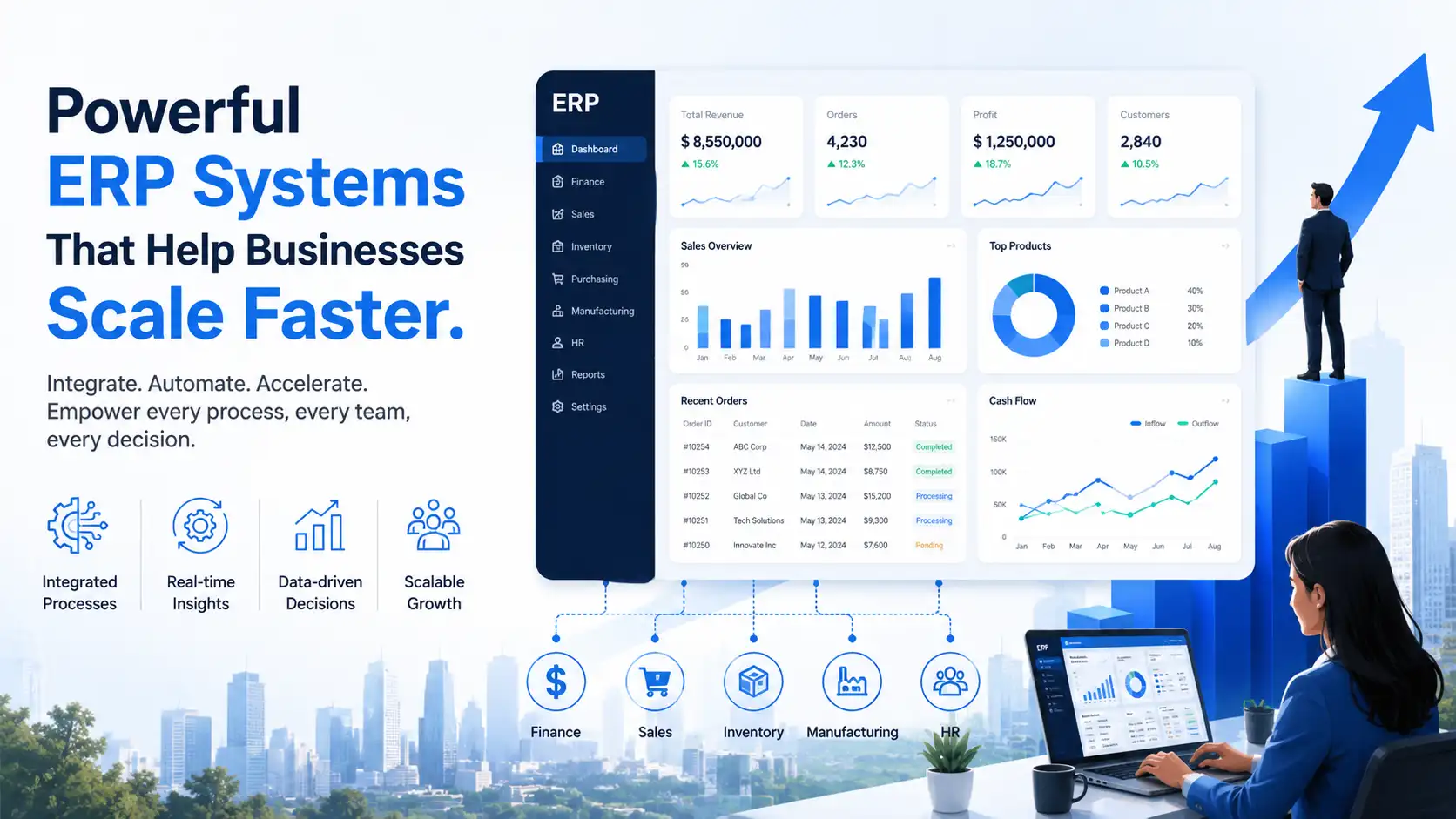
ERP, short for Enterprise Resource Planning, helps businesses connect their core operations into one centralized system that improves efficiency, communication, and decision-making. Instead of relying on separate tools for accounting, inventory management, payroll, customer service, human resources, and sales tracking, businesses can manage everything inside one integrated platform. This not only reduces operational confusion but also helps companies improve productivity while saving time and reducing costly mistakes.
In today’s highly competitive business world, companies that scale successfully are usually the ones that automate early, analyze data efficiently, and build systems capable of supporting long-term growth. Businesses that continue relying on outdated manual processes often struggle to keep up as operational complexity increases. That’s why modern ERP software has become one of the most important investments for businesses looking to grow faster, improve efficiency, and stay competitive in rapidly evolving markets.
Introduction to ERP Systems
ERP systems are designed to unify business operations into a single platform that improves visibility, communication, and workflow management across every department. Instead of using separate software tools for payroll, accounting, sales management, inventory tracking, customer support, and employee management, companies can organize everything inside one centralized ecosystem.
Think of ERP software as the nervous system of a business because every department communicates through it. Information flows more efficiently, employees collaborate more effectively, and leadership teams gain better visibility into daily operations. Instead of wasting time manually transferring data between systems or correcting avoidable errors, businesses can focus on improving performance and supporting growth.
Modern ERP platforms are also cloud-based, meaning businesses can access critical information from virtually anywhere. Whether employees work inside an office, remotely from home, or across multiple countries, cloud ERP systems help teams stay connected while maintaining operational consistency. This level of accessibility has become especially important as remote and hybrid work environments continue becoming more common across industries worldwide.
Why Modern Businesses Need ERP Software
Business growth sounds exciting and it absolutely is, but scaling also comes with serious operational challenges that many companies underestimate. As businesses grow larger, daily operations naturally become more complicated. Teams expand, customer demands increase, workflows become harder to manage, and decision-making requires more accurate data than ever before.
Without proper systems in place, growth can quickly turn into operational chaos.
Businesses that rely heavily on spreadsheets, disconnected software tools, and manual reporting processes often struggle to maintain efficiency as operations expand. Small mistakes that once seemed harmless can eventually create major financial losses, inventory issues, communication failures, and customer dissatisfaction. ERP software helps businesses maintain structure while supporting continuous growth, allowing companies to scale operations without losing control of productivity or organizational efficiency.
The Growing Challenges of Scaling a Business
As businesses expand, they often face issues like:
- Disorganized workflows
- Inventory mistakes
- Delayed reporting
- Poor communication between departments
- Data duplication
- Slow decision-making
These challenges may seem manageable at first, but they become increasingly damaging as operations continue growing. Imagine trying to track hundreds or even thousands of customer orders using spreadsheets alone. Eventually, mistakes become unavoidable. Orders get delayed, inventory numbers become inaccurate, reports arrive too late, and employees waste valuable time fixing preventable issues instead of focusing on growth opportunities.
Poor communication between departments can also create major operational bottlenecks. For example, the sales team may promise product availability without realizing inventory levels are already low, while finance teams struggle to generate accurate reports because information exists across multiple disconnected systems. ERP software helps solve these problems by centralizing information and improving coordination across the organization.
How ERP Platforms Solve Operational Bottlenecks
ERP software streamlines operations by automating repetitive tasks and organizing information in real time. Instead of manually updating reports or constantly transferring information between different software tools, businesses can instantly access dashboards showing:
- Revenue performance
- Inventory levels
- Employee productivity
- Sales forecasts
- Customer behavior
This level of visibility allows business leaders to make faster and smarter decisions while improving operational coordination across departments. Managers no longer need to wait days or weeks for updated reports because ERP systems provide real-time information instantly.
Businesses that react quickly to operational changes usually gain a stronger competitive advantage. If inventory starts running low, managers can respond immediately. If customer demand suddenly increases, teams can adjust workflows faster. ERP software transforms businesses from reactive organizations constantly fixing problems into proactive organizations capable of anticipating challenges before they become serious issues.
What Makes an ERP System Powerful?
Not all ERP systems are built the same. Some are designed specifically for large enterprise corporations with highly complex operational structures, while others are ideal for startups and mid-sized businesses looking for flexibility and affordability. The most powerful ERP systems are the ones capable of simplifying workflows, improving productivity, automating repetitive tasks, and scaling alongside the business as operations continue growing.
Modern businesses need ERP systems that can adapt quickly to changing operational demands while remaining efficient, accessible, and easy to use.
Automation and Workflow Management
A strong ERP platform automates repetitive tasks like invoicing, payroll processing, order management, inventory tracking, and financial reporting. Automation reduces human error while saving massive amounts of time, allowing employees to focus on higher-value tasks that directly contribute to business growth and customer satisfaction.
Think about how much time employees waste manually entering the same information into multiple systems every day. ERP software eliminates much of that unnecessary work by centralizing information and automating repetitive workflows. It’s almost like having an invisible employee working behind the scenes twenty-four hours a day to keep operations running smoothly and efficiently.
Automation also improves accuracy significantly. Human errors in accounting, inventory management, or customer data can create expensive operational problems. ERP systems reduce these risks while improving consistency across the organization.
Real-Time Data and Analytics
Data is often called the new oil because information has become one of the most valuable assets businesses possess. However, raw data alone isn’t useful without proper analysis. The best ERP systems transform complex business information into actionable insights through dashboards, analytics, and advanced reporting tools.
Real-time analytics help businesses react faster to market trends, customer demands, and operational challenges. Managers can monitor performance instantly instead of relying on outdated reports that no longer reflect current business conditions. This level of visibility improves decision-making while helping businesses identify opportunities and risks much faster than competitors relying on slower reporting processes.
Businesses that understand their data clearly often outperform companies operating based on assumptions alone. ERP analytics help organizations improve forecasting accuracy, optimize operations, and create smarter long-term growth strategies.
Cloud Accessibility and Scalability
Cloud ERP systems are especially valuable because they grow alongside the business. Instead of replacing software every few years due to operational limitations, businesses can scale users, storage capacity, and functionality as needed without major disruptions.
Cloud accessibility also allows employees to access important information remotely using laptops, tablets, or smartphones. This flexibility has become extremely important in today’s business environment where remote work and global collaboration continue increasing.
Scalability matters because growing businesses need systems capable of supporting expansion without requiring complete replacement. The best ERP platforms continue supporting businesses as operations become larger, more complex, and more demanding over time.
Top 6 Powerful ERP Systems That Help Businesses Streamline Operations and Scale Business Growth Faster in 2026
Choosing the right ERP system can completely transform how a business operates, especially when growth starts happening faster than expected. A powerful ERP platform does much more than organize company data because it helps businesses automate workflows, improve communication between departments, reduce costly mistakes, and make smarter decisions using real-time analytics.
Whether you run a startup, a mid-sized company, or a large enterprise corporation, investing in the right ERP software can create a stronger operational foundation for long-term success. Below are six of the most powerful ERP systems businesses are using to improve efficiency, support scalability, and remain competitive in today’s rapidly evolving digital marketplace.
1. SAP S/4HANA
SAP has long been considered one of the biggest names in the ERP industry, and SAP S/4HANA continues that reputation by offering enterprise-level functionality designed for large organizations managing highly complex operations. This ERP platform focuses heavily on real-time processing, advanced analytics, automation, and operational visibility.
Companies operating across multiple countries often rely on SAP S/4HANA because it can handle enormous amounts of business data while maintaining speed, efficiency, and accuracy across departments. Its ability to centralize operations makes it one of the most trusted ERP systems for corporations aiming to improve productivity while scaling globally.
Key Features of SAP S/4HANA
Some standout features include:
- Real-time financial reporting
- AI-driven analytics
- Supply chain optimization
- Advanced inventory management
- Integrated procurement systems
These features help businesses gain stronger operational visibility while improving efficiency and reducing costly delays. SAP S/4HANA processes huge amounts of information incredibly fast thanks to its in-memory computing technology. This allows businesses to generate reports instantly, monitor operational performance more effectively, and respond to market changes much faster than companies still relying on outdated systems.
The platform also improves collaboration between departments because every team operates using centralized real-time data. Finance teams can generate reports more accurately, supply chain managers can optimize inventory movement, and executives can make strategic decisions faster using updated operational insights. This combination of speed, automation, and scalability makes SAP one of the strongest ERP systems available for enterprise organizations.
Best Businesses for SAP S/4HANA
SAP works best for:
- Large enterprises
- Manufacturing companies
- Global supply chain businesses
- Corporations with complex operations
Businesses operating internationally often benefit the most because SAP S/4HANA is designed to manage large-scale workflows and detailed operational processes efficiently. Manufacturing companies especially value SAP’s ability to optimize production planning, logistics management, and procurement operations within one connected system.
Although implementation costs can be expensive and setup may require specialized expertise, many organizations consider the investment worthwhile because of its long-term scalability and enterprise-grade functionality. Large corporations often choose SAP because they need software capable of supporting operations across multiple countries, departments, and regulatory environments simultaneously.
2. Oracle NetSuite
Oracle NetSuite is one of the world’s most popular cloud ERP systems because it combines scalability, flexibility, and user-friendly functionality into one powerful platform. Businesses looking for a cloud-first ERP solution often choose NetSuite because it offers advanced operational tools without requiring expensive infrastructure or overly complicated implementation processes.
Its cloud-based structure also makes it easier for businesses to support remote teams while maintaining centralized visibility into operations. Companies operating across multiple locations often appreciate the platform’s accessibility because employees can securely access important business information from virtually anywhere.
Why NetSuite Is Popular Among Growing Companies
NetSuite offers businesses a complete suite of tools including:
- Financial management
- CRM functionality
- Inventory tracking
- E-commerce integration
- Order management
These tools help businesses centralize operations while improving workflow efficiency and reducing dependency on disconnected software systems. NetSuite’s cloud infrastructure allows businesses to scale faster because everything operates online without requiring large hardware investments or complicated maintenance systems.
Businesses also benefit from real-time dashboards and analytics that provide instant visibility into operational performance, helping leadership teams make faster and smarter decisions. Managers can monitor inventory movement, financial reports, customer behavior, and operational productivity inside one connected platform without constantly switching between separate applications.
The flexibility of NetSuite is another reason why it remains highly popular among rapidly growing companies. Businesses can expand functionality gradually as operational needs evolve, allowing organizations to continue scaling without replacing their ERP infrastructure entirely.
Best Businesses for Oracle NetSuite
NetSuite works best for:
- Mid-sized businesses
- E-commerce companies
- Fast-growing startups
- Service-based businesses
Businesses experiencing rapid operational growth often benefit the most from NetSuite because the platform is specifically designed to scale alongside expanding organizations without requiring major infrastructure upgrades. E-commerce businesses especially value the platform’s ability to centralize inventory tracking, online sales management, financial reporting, and customer relationship management within one connected ecosystem.
Service-based businesses also appreciate NetSuite’s strong reporting capabilities because they can monitor operational performance, customer engagement, and financial activity more efficiently. Although pricing can increase as businesses add advanced features and customization tools, many organizations still consider NetSuite a worthwhile investment because of its cloud accessibility, scalability, and operational flexibility.
3. Microsoft Dynamics 365
Microsoft Dynamics 365 combines ERP and CRM functionality into one highly connected ecosystem. Businesses already using Microsoft tools like Excel, Outlook, Teams, and Power BI often find Dynamics 365 especially attractive because of its seamless integration capabilities and familiar interface structure.
This familiarity reduces implementation friction while helping employees adapt more quickly to the platform without requiring extensive retraining. Organizations looking for a scalable ERP solution capable of supporting both operational management and customer engagement often choose Dynamics 365 because it offers strong cloud functionality, enterprise-level security, and flexible modules that adapt alongside business growth.
Integration Advantages
One of Dynamics 365’s biggest strengths is integration.
It works seamlessly with:
- Microsoft Office
- Power BI
- Azure cloud services
- Microsoft Teams
This creates a highly connected digital workplace where employees can collaborate, analyze data, and manage operations more efficiently. Businesses already using Microsoft software often experience smoother implementation because employees are already comfortable with the software environment and workflow structure.
Dynamics 365 also allows companies to centralize reporting, communication, and operational management while improving visibility into customer behavior, financial performance, and team productivity. Employees can collaborate more effectively using integrated communication tools while leadership teams gain stronger insights through advanced analytics and reporting dashboards.
This level of operational connectivity helps organizations improve decision-making while reducing inefficiencies caused by fragmented systems and manual data transfers. For businesses already operating heavily within the Microsoft ecosystem, Dynamics 365 often becomes one of the most practical and scalable ERP choices available.
Industries That Benefit Most
Dynamics 365 works especially well for:
- Retail businesses
- Financial services
- Healthcare organizations
- Service-based companies
These industries often require strong customer relationship management, real-time reporting, and seamless communication between departments. Retail companies benefit from real-time inventory tracking and customer analytics, while financial organizations use the platform to improve reporting accuracy and operational visibility.
Healthcare providers also appreciate Dynamics 365 because of its ability to centralize patient-related workflows and compliance-focused operational processes. Service-based businesses benefit from improved collaboration, scheduling, and customer management tools that help teams operate more efficiently while maintaining high service quality.
The platform’s modular structure allows businesses to start with essential tools before gradually expanding functionality as operational needs continue growing, making it highly adaptable for organizations planning long-term expansion.
You can also read the related article These 5 Android Apps Can Replace Your Webcam Easily
to discover useful Android apps that can improve productivity, remote meetings, streaming setups, and everyday digital workflows more efficiently.
4. Odoo ERP
Odoo has become increasingly popular among startups and small businesses because of its affordability, flexibility, and customization capabilities. Unlike many enterprise-focused ERP systems, Odoo offers a more approachable and lightweight experience without sacrificing important functionality.
Its modern interface and open-source flexibility make it highly attractive for growing businesses with evolving operational requirements. Companies that need scalable ERP software without massive upfront investment costs often choose Odoo because it allows them to customize workflows according to specific operational needs.
Flexibility and Open-Source Advantages
Odoo stands out because it’s open-source.
This means businesses can customize the platform extensively without being trapped inside rigid software structures.
Modules include:
- Accounting
- Inventory
- Sales
- HR
- Marketing automation
- Project management
Businesses can install only the tools they actually need, helping reduce unnecessary complexity while keeping operations cost-efficient. This modular structure allows organizations to scale functionality gradually instead of paying for features they may never use.
Odoo’s customization flexibility is especially valuable for startups and smaller businesses with unique workflows that don’t fit inside traditional ERP structures. Companies can adapt the platform according to operational requirements while still maintaining centralized visibility across departments.
This balance between affordability, scalability, and customization has helped Odoo become one of the fastest-growing ERP solutions among small and mid-sized businesses worldwide.
Why Small Businesses Love Odoo
Small businesses often choose Odoo because:
- It’s budget-friendly
- It’s easy to customize
- It supports rapid growth
- The interface feels modern and clean
These advantages allow startups and growing businesses to access powerful ERP functionality without spending enormous amounts of money on enterprise-level platforms. Odoo’s clean interface also helps reduce employee training time, making adoption smoother for smaller teams with limited technical resources.
Businesses experiencing rapid growth appreciate the platform’s ability to scale gradually while continuing to support evolving workflows and increasing operational complexity. For startups trying to maximize efficiency without overextending budgets, Odoo often becomes one of the most practical ERP solutions available.
5. Infor CloudSuite
Infor CloudSuite focuses heavily on industry-specific ERP solutions designed for sectors like manufacturing, healthcare, hospitality, retail, and distribution. Instead of offering generic workflows intended for every company, Infor creates specialized functionality tailored around industry-specific operational challenges and compliance requirements.
This approach helps businesses improve efficiency while reducing the need for excessive customization. Companies operating in highly specialized industries often choose Infor CloudSuite because it provides operational workflows already aligned with industry standards, allowing organizations to improve productivity while adapting more quickly to changing regulations and market demands.
Industry-Specific ERP Capabilities
Infor understands that different industries have unique operational challenges.
For example:
- Manufacturers need production planning
- Healthcare providers need compliance tools
- Retailers need supply chain optimization
Infor designs workflows specifically around these operational needs, helping businesses improve efficiency while reducing the complexity often associated with implementing generic ERP systems. Manufacturers benefit from production scheduling and inventory optimization tools, while healthcare providers use compliance-focused functionality to improve operational consistency and reporting accuracy.
Retail businesses also appreciate Infor’s supply chain management capabilities because they help organizations improve inventory visibility while reducing fulfillment delays and operational waste. This industry-focused approach allows businesses to spend less time customizing workflows and more time improving operational performance.
AI and Predictive Analytics Features
Infor also integrates artificial intelligence into its platform.
Its predictive analytics tools help businesses:
- Forecast demand
- Reduce inventory waste
- Predict maintenance issues
- Improve workforce planning
These intelligent capabilities allow businesses to make more proactive decisions instead of constantly reacting to problems after they appear. Businesses can analyze trends more effectively, optimize resource allocation, and improve planning accuracy using real-time predictive insights generated by the system.
Predictive analytics also helps organizations reduce unnecessary operational costs while improving long-term efficiency and customer satisfaction. Companies operating in highly competitive industries often rely on these AI-driven insights to improve decision-making and maintain stronger operational performance compared to competitors still relying heavily on manual forecasting processes.
6. Acumatica Cloud ERP
Acumatica has quietly become one of the most respected cloud ERP systems for mid-sized businesses because it combines simplicity, flexibility, and powerful operational functionality inside an intuitive platform. Businesses often choose Acumatica because it delivers enterprise-level capabilities without overwhelming users with unnecessary complexity.
Its cloud-based infrastructure also makes it highly attractive for organizations supporting remote teams and multi-location operations. Companies experiencing steady growth often rely on Acumatica because the platform offers scalability, accessibility, and cost efficiency while maintaining strong operational visibility across departments.
User-Friendly Cloud Features
Acumatica offers:
- Mobile accessibility
- Real-time dashboards
- Project accounting
- Inventory tracking
- Financial management
These features help businesses maintain operational visibility while improving collaboration between departments and remote employees. Real-time dashboards allow organizations to monitor financial performance, inventory activity, and operational productivity instantly without relying on delayed manual reporting processes.
Mobile accessibility also makes it easier for employees and executives to stay connected while traveling or working remotely. The platform’s intuitive interface significantly reduces employee training time, allowing businesses to implement the system more efficiently without creating major operational disruptions during adoption.
Businesses also appreciate Acumatica’s flexibility because it allows organizations to customize workflows while maintaining strong cloud accessibility and operational performance.
Cost Efficiency for Expanding Businesses
Unlike some ERP providers that charge per user, Acumatica uses resource-based pricing.
This can become highly cost-effective for growing businesses because companies don’t face rapidly increasing licensing expenses every time they hire additional employees or expand operational teams.
Businesses often appreciate this pricing structure because it allows organizations to scale operations more predictably while maintaining better control over long-term software expenses. Mid-sized companies planning future expansion especially benefit from this flexibility because they can continue growing without constantly worrying about sharply increasing ERP licensing costs.
Combined with its cloud accessibility, operational functionality, and scalability, Acumatica has become one of the most attractive ERP solutions for businesses wanting enterprise-level performance without excessive complexity or unpredictable pricing structures.
How to Choose the Right ERP System
Choosing an ERP system is a major business decision because the wrong choice can create operational frustration for years while the right platform can accelerate growth dramatically. Businesses should carefully evaluate their operational requirements, scalability goals, and long-term plans before making a final decision.
Understanding Your Business Needs
Before selecting ERP software, businesses should identify:
- Operational pain points
- Growth goals
- Department requirements
- Existing software limitations
An ERP system should solve real operational problems instead of simply adding another layer of complexity. Companies that carefully evaluate their needs before implementation usually achieve stronger long-term results.
Budget and Scalability Considerations
Budget matters, but focusing only on price can backfire. Cheap systems may lack scalability, forcing businesses to replace software later and creating expensive operational disruptions. The best ERP systems continue supporting businesses as operational complexity increases over time.
Integration With Existing Tools
Integration is critical.
ERP software should connect smoothly with tools your business already uses, including:
- CRM systems
- E-commerce platforms
- Payment processors
- HR software
Disconnected systems create operational friction that slows productivity while increasing manual work. Businesses prioritizing integration often achieve stronger efficiency because information flows smoothly across departments.
Common Mistakes Businesses Make When Choosing ERP
Many companies rush into ERP decisions without proper planning.
Some common mistakes include:
- Choosing based only on price
- Ignoring scalability
- Underestimating employee training
- Failing to plan implementation properly
- Selecting overly complex systems
ERP implementation affects workflows, communication, reporting, and operational structure across the entire organization. Businesses investing time into planning, employee training, and process optimization usually achieve far better long-term outcomes.
ERP Trends That Will Shape the Future
ERP technology continues evolving rapidly, and the future looks smarter, faster, and more automated than ever before. Businesses increasingly rely on AI-driven analytics, cloud accessibility, and predictive automation to improve operational performance while remaining competitive in modern digital markets.
Artificial Intelligence in ERP
AI-powered ERP systems can now:
- Predict customer demand
- Automate financial forecasting
- Detect fraud patterns
- Recommend operational improvements
AI transforms ERP systems from passive operational tools into active business advisors capable of helping organizations make smarter and more proactive decisions.
Mobile ERP and Remote Work
Modern businesses increasingly rely on remote teams.
Mobile ERP platforms allow employees to:
- Access reports anywhere
- Approve workflows remotely
- Track inventory on mobile devices
- Communicate in real time
Business no longer happens only inside office walls. Mobile ERP functionality allows organizations to maintain productivity and operational visibility even when employees work remotely.
Predictive Analytics and Automation
Predictive analytics is becoming a major competitive advantage because businesses can anticipate problems before they occur instead of constantly reacting after issues appear. This shift from reactive management to proactive planning is transforming industries worldwide while improving efficiency and operational accuracy.
Conclusion
Scaling a business is exciting, but growth without structure can quickly become overwhelming. That’s why ERP systems play such an important role in modern business operations. The right ERP platform helps companies automate workflows, improve communication between departments, reduce operational inefficiencies, and make smarter decisions using real-time data and analytics. Whether it’s SAP S/4HANA for enterprise corporations, Oracle NetSuite for growing companies, Microsoft Dynamics 365 for integrated business management, Odoo for affordable flexibility, Infor CloudSuite for industry-specific operations, or Acumatica for scalable cloud functionality, each ERP system offers unique advantages that can help businesses grow faster and operate more efficiently.
At the end of the day, ERP software is more than just a technology investment because it creates a stronger operational foundation for long-term success. Businesses that implement the right ERP solution often improve productivity, increase operational visibility, and adapt more effectively to changing market demands. As digital transformation continues shaping the future of business, companies that embrace scalable ERP systems will be better prepared to remain competitive, efficient, and ready for sustainable growth.
FAQs
1. What does ERP stand for?
ERP stands for Enterprise Resource Planning. It refers to software designed to help businesses manage operations like finance, inventory, HR, sales, customer service, and reporting within one centralized platform.
2. Which ERP system is best for small businesses?
Odoo and Acumatica are often considered excellent choices for small and growing businesses because they offer flexibility, scalability, affordability, and strong customization capabilities.
3. Is cloud ERP better than on-premise ERP?
Cloud ERP is generally more flexible, easier to maintain, and better for remote accessibility. However, some large enterprises still prefer on-premise systems for specific security or compliance requirements.
4. How long does ERP implementation take?
Implementation timelines vary depending on company size and operational complexity. Smaller businesses may complete implementation within several months, while enterprise corporations may require a year or longer.
5. Can ERP systems improve productivity?
Absolutely. ERP systems automate repetitive tasks, improve communication, reduce manual errors, centralize business data, and provide real-time insights that help employees work more efficiently and productively.